

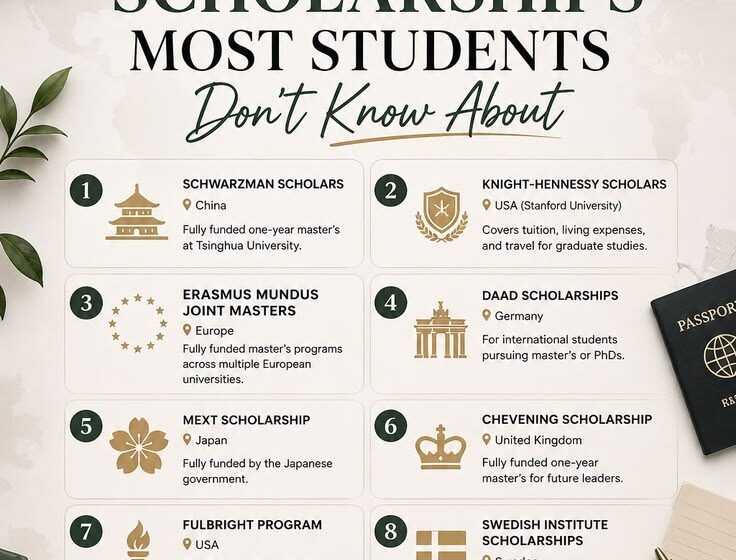
What International Scholarships Are Available for Students?

International scholarships provide students with opportunities to study at universities and educational institutions outside their home countries. These awards can make international education more affordable by covering tuition fees, living expenses, travel costs, accommodation, and other study-related expenses.
Many scholarships are funded by governments, universities, charitable foundations, and international organisations. Some are available to undergraduate students, while others are designed for master’s students, doctoral candidates, researchers, or professionals seeking further education.
If you want to study abroad but are concerned about the cost, exploring international scholarship opportunities is an excellent place to start.
1. Chevening Scholarships in the United Kingdom
Chevening is a well-known scholarship programme funded by the UK government. It supports eligible students who want to pursue a one-year master’s degree at a participating UK university.
The programme is particularly interested in applicants who demonstrate leadership potential, professional achievement, and a commitment to making a positive contribution to their communities.
Depending on the award conditions, funding covers major study expenses, including tuition fees and living costs, with eligible travel expenses also supported.
Applicants generally need an appropriate undergraduate qualification, relevant work experience, and admission to an eligible master’s course. The exact requirements should be checked against the official guidance for the relevant application cycle.
Students interested in postgraduate education can explore the official Chevening Scholarships website to review participating countries, eligibility requirements, and application instructions.
2. Fulbright Foreign Student Program in the United States
The Fulbright Foreign Student Program provides opportunities for eligible international students, young professionals, and artists to study or conduct research in the United States.
The programme primarily supports graduate-level study and research, including master’s and doctoral opportunities. It also promotes cultural exchange and international understanding.
Depending on the country and award, benefits may include funding support, visa sponsorship, health-related benefits, and academic enrichment activities.
The application process differs between countries. In many cases, applicants must apply through a Fulbright commission, foundation, or the relevant US embassy.
Students should review the requirements carefully because eligible fields, application procedures, deadlines, and funding arrangements vary.
For details, visit the official .
3. Erasmus Mundus Joint Masters Scholarships in Europe
Erasmus Mundus Joint Masters scholarships offer students the opportunity to pursue master’s degrees delivered by international groups of universities.
These programmes often involve studying in more than one country, giving students exposure to different academic systems, cultures, and research environments.
Eligible scholarship recipients may receive support for participation costs, travel, visa expenses, and living costs, according to the programme’s funding arrangements.
Students typically need a bachelor’s degree or an equivalent qualification. Applicants in the final year of their undergraduate studies may also be eligible if they graduate before the master’s programme begins.
One important advantage is that students can explore programmes across different academic disciplines rather than being restricted to one university or destination.
Applications are usually submitted directly to the institution or consortium offering the selected programme. Many programmes accept applications between October and January for courses beginning in the following academic year, although deadlines differ.
Explore available courses and funding information through the official .
4. DAAD Scholarships in Germany
The German Academic Exchange Service, commonly known as DAAD, provides scholarships and other funding opportunities for international students, graduates, doctoral candidates, and researchers.
Many DAAD programmes focus on postgraduate education, research, and academic development. Available opportunities depend on the applicant’s country, qualification, subject area, and intended programme.
Scholarship benefits vary, but some awards provide monthly financial support, travel allowances, and insurance benefits.
Germany may be an attractive destination for students interested in engineering, science, technology, economics, environmental studies, and other academic fields. However, applicants should confirm whether their preferred course is eligible and whether German-language proficiency is required.
The best way to identify suitable opportunities is to search the DAAD scholarship database and review the requirements for each award.
Visit the official for information about available funding.
5. Australia Awards Scholarships
Australia Awards Scholarships are funded by the Australian government and are intended to support education and development in eligible partner countries.
These scholarships can provide opportunities for eligible international students to undertake undergraduate or postgraduate study at participating Australian institutions, depending on the programme and country arrangements.
Benefits generally include tuition fees, return economy-class airfare, a contribution towards living expenses, and an establishment allowance. Eligible recipients may also receive health insurance and certain academic support benefits.
However, eligibility is not universal. Participating countries, eligible study areas, and application requirements vary, and some awards have specific development priorities.
Applicants should also understand the scholarship conditions before accepting an offer. For example, Australia Awards recipients are generally required to leave Australia for at least two years after completing their scholarship.
Visit the official to check country eligibility and application dates.
6. Japanese Government MEXT Scholarships
The Japanese government offers scholarships through the Ministry of Education, Culture, Sports, Science and Technology, commonly known as MEXT.
These awards cover several categories, including undergraduate study, research programmes, teacher training, Japanese studies, and specialised technical education.
Depending on the category, scholarship benefits may include tuition coverage, a monthly allowance, and airfare under the applicable conditions.
Applications are generally made through one of two routes: a recommendation from a Japanese embassy or consulate, or a recommendation from a Japanese university.
The eligibility criteria depend on the scholarship category. Applicants should check age limits, academic qualifications, subject requirements, language expectations, and examination procedures.
Students interested in studying in Japan can consult the official .
7. Commonwealth Scholarships in the United Kingdom
Commonwealth Scholarships support eligible students from participating Commonwealth countries who want to pursue postgraduate study in the United Kingdom.
Many awards focus on development-related subjects and aim to help students gain knowledge and skills that can benefit their home countries.
Depending on the particular scholarship, funding may include tuition fees, approved travel expenses, and a living allowance.
Eligibility depends on the award category. Applicants may need an appropriate undergraduate qualification, citizenship or residency in an eligible country, and a proposed course that meets the programme’s objectives.
Some opportunities also involve nomination by an authorised organisation or national body.
Because there are different Commonwealth scholarship schemes, students should identify the specific award relevant to their education level and nationality.
Official information is available through the .
8. University-Specific International Scholarships
Many universities offer their own scholarships to attract talented students from around the world.
These awards may be based on academic achievement, financial need, leadership, research potential, or a particular area of study.
Some universities offer fully funded scholarships, while others provide partial tuition reductions or fixed financial awards.
For example, a university may offer a merit scholarship to students with excellent academic records. Another institution may provide financial support to international students studying engineering, business, public health, or computer science.
University scholarships can be particularly useful because applicants may find opportunities that are not widely advertised through national scholarship programmes.
To explore these options, visit the official websites of universities you are interested in and look for sections titled “Scholarships,” “Financial Aid,” or “Funding for International Students.”
Check whether you must receive an admission offer before applying for the scholarship. Some universities assess scholarship eligibility automatically, while others require a separate application.
9. How Can You Qualify for an International Scholarship?
Although requirements differ, several factors commonly influence scholarship eligibility.
Academic performance: Many scholarships consider grades, previous qualifications, and academic achievements.
Nationality and residency: Some awards are open to students worldwide, while others are restricted to applicants from specific countries.
Education level: Scholarships may be designed for undergraduate students, master’s students, doctoral candidates, or researchers.
English-language proficiency: Some programmes require an English-language test or other evidence of language ability. Requirements depend on the scholarship and university.
Leadership and community involvement: Certain awards value volunteering, professional experience, leadership, and evidence of community impact.
Study objectives: Applicants may need to explain why they selected a particular course and how it relates to their future plans.
Meeting the minimum requirements does not guarantee an award. Scholarships can be competitive, so a strong application should clearly demonstrate why you are a suitable candidate.
10. How Can You Apply for International Scholarships?
Start by identifying your preferred destination, academic level, and field of study. This helps you narrow your search to programmes that match your qualifications and goals.
Next, research official scholarship websites and confirm that applicants from your country are eligible.
Prepare the documents commonly requested, such as:
- Academic transcripts and certificates.
- A CV or résumé.
- A personal statement or motivation letter.
- Letters of recommendation.
- Proof of language proficiency, if required.
- A research proposal for certain postgraduate programmes.
- Identification documents and any additional forms specified by the provider.
Apply for university admission when required, and submit your scholarship application according to the stated procedure.
Keep track of deadlines because scholarship applications may close months before the academic year begins. Submit your documents early enough to address any missing information.
Finally, monitor your email and application account for updates, interview invitations, or requests for additional documents.
11. How Can You Avoid Scholarship Scams?
Students searching for international funding should be careful about fraudulent scholarship advertisements.
Be suspicious of anyone who guarantees a scholarship in exchange for an unofficial payment or claims that you must pay a personal agent to secure an award.
Always verify scholarship information through the official government, university, or funding organisation website.
Do not share passwords, banking PINs, or unnecessary personal information with unknown recruiters. If an offer seems unusual, contact the scholarship provider using independently verified contact details.
Remember that legitimate scholarships have published eligibility rules and formal application procedures. Some legitimate services may charge fees for separate services, but you should never assume that a payment request is genuine without verifying it.
Conclusion
International scholarships can help students access educational opportunities abroad while reducing the financial burden of tuition and living expenses.
Options such as Chevening, Fulbright, Erasmus Mundus, DAAD, Australia Awards, MEXT, Commonwealth Scholarships, and university-specific awards serve different groups of students and have different eligibility requirements.
The best approach is to identify scholarships that match your nationality, academic qualifications, preferred destination, and field of study. Prepare your documents carefully, follow official application procedures, and keep track of deadlines.
With early planning and a well-prepared application, you can improve your chances of finding financial support for your international education.




Leave a Reply