

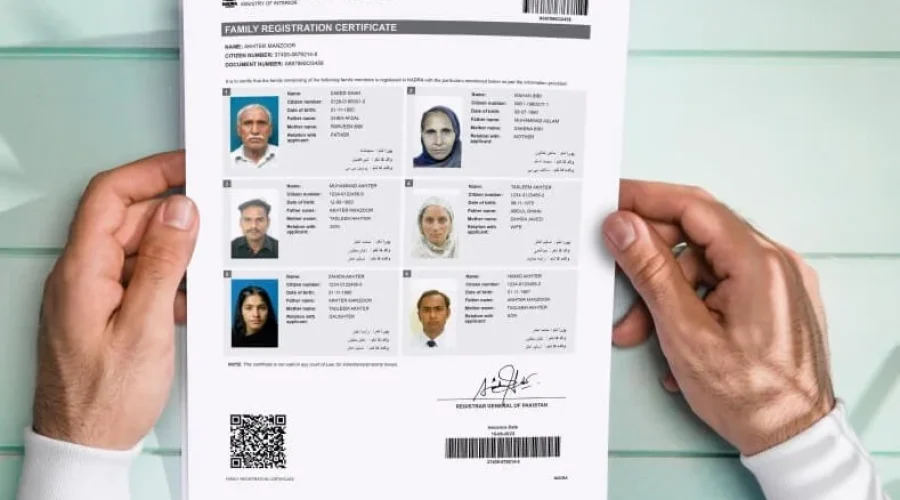
NADRA FRC 2026: Online Apply, Fee, Documents & Types
A Family Registration Certificate (FRC) is the document that puts your family on official record — verified against NADRA’s own database, not typed by you. It is the paper that visa officers, immigration departments and institutions ask for when they need to see who you are actually related to. This guide explains what an FRC is, which of the four categories applies to you, what it costs, what you must take with you, and how to apply online through NADRA Pak Identity instead of standing in a queue at a Registration Centre.
Last verified: 18 October 2026. FRC fees and processing timelines are revised from time to time. Confirm the current amount on NADRA’s official fee page before you pay anything.
What is a Family Registration Certificate?
NADRA defines it plainly: the FRC is “a certificate issued by the NADRA which reflects, verifies and provides a record of the family composition data of a registered person.” It is issued under Rule 19 of the NADRA (NIC) Rules, 2002, and NADRA states it serves as valid proof of a person’s family composition data, generally used for immigration, visa processing and other legal or administrative purposes.
That definition carries two points most applicants miss:
- It records relationships, not just names. The FRC links you to other registered persons — parents, spouse, children, siblings or a legal guardian, depending on the category you apply under.
- It is not a replacement for your CNIC, B-Form or NICOP. Those prove who you are. The FRC proves how you are related. Institutions normally ask for both.
Types of FRC — Pick the Right Category First
NADRA issues the FRC in four categories. Selecting the wrong one is the most common reason an application is returned or re-done, so decide this before you start filling anything in.
| Category | What the certificate lists |
|---|---|
| By Birth | Details of your parents and siblings |
| By Marriage | Details of your spouse and children |
| By Adoption | Details of your legal guardian and adopted family members |
| By All | Details of both alpha and beta family members combined |
A practical note: NADRA’s official fee schedule groups FRC charges as “Alpha / Beta / Gama family” and a separate “FRC (Both)” option. If you are unsure which of these maps to the category you need — for example, an FRC by marriage where the spouse’s family side also matters — call the NADRA helpline 1777 before paying, rather than guessing at the counter.
Which category do most people need?
- Applying for a family visa or immigration sponsorship — usually By Marriage (spouse and children) or By Birth (parents and siblings), depending on who is sponsoring whom.
- School, college or scholarship paperwork — most often By Birth, since the institution wants to see parents and siblings.
- Guardianship or adoption matters — By Adoption.
- A single document covering your whole family tree — By All.
Who Can Apply — Eligibility Rules
To be eligible for an FRC, all family members you want listed must be registered with NADRA and hold a valid 13-digit identification number. NADRA’s own wording leaves a narrow door open for edge cases: unregistered deceased individuals, and in certain scenarios living individuals, can also be included, with their particulars recorded exactly as provided by the applicant. That exception is handled case by case at the centre — it is not something you can complete through an online form.
So before you apply, check one thing: are the family members you want on the certificate already in NADRA’s database with a CNIC, B-Form/CRC, NICOP or POC? If a child’s B-Form was never issued, or a spouse’s record has an old address or a spelling error, fix that first. An FRC cannot register someone who is not registered.
Documents and Information You Need
NADRA’s stated requirement for the FRC is straightforward:
- The 13-digit ID number of the applicant — from a CRC/Juvenile Card, CNIC, NICOP or POC.
In practice, when you apply by marriage or include children, the centre will also need the 13-digit ID numbers of your spouse and children, so keep those written down before you arrive. Take original identity documents with you for verification, and keep photocopies as backup. Because requirements can vary slightly between centres for special cases, the safest move is to call 1777 or check the NADRA office locator and confirm what your specific centre wants that day.
FRC Fee and Processing Time
NADRA’s published fee schedule lists:
| Item | Fee | Timeline shown |
|---|---|---|
| FRC (Alpha / Beta / Gama family — one side) | PKR 1,000 | Executive: 1 day |
| FRC (Both) | PKR 2,000 | Executive: 1 day |
Overseas applicants applying through a consulate or the Pak Identity portal are charged in the local currency — for example, UK consular listings show FRC around £6.50 — and online applicants report receiving a PDF copy by email, often within about 24 hours of payment. Treat those overseas and online timelines as indicative rather than guaranteed; NADRA notes that the Normal, Urgent and Executive timelines start only after fee payment is confirmed.
Important: fee amounts in this article were accurate as of the date stamped at the top, but NADRA revises its fee structure periodically. Always open the official NADRA fee structure page or the Pak Identity fee page and confirm the number on the day you apply. Do not pay an agent based on a figure you read on a blog — including this one.
How to Apply for an FRC — Two Routes
Route 1: In person at a NADRA Registration Centre (NRC)
This remains the standard route and the only realistic option for complicated family situations.
- Find your nearest NRC using NADRA’s office locator, and note its working hours before travelling.
- Carry the originals — CNIC (or NICOP/POC) plus the identity documents of the family members you are listing.
- Tell the operator which category you need (By Birth, By Marriage, By Adoption or By All).
- Complete biometric verification — your fingerprints and photograph are captured at the counter.
- Pay the fee and collect your receipt with the tracking number.
- Collect the certificate from the same centre once it is printed, or track it using the receipt.
If you are applying by marriage and there are children under 18 to be included, guides covering the process report that the children may need to be present at the time of application. Confirm this with your centre in advance — turning up without them can mean a wasted trip.
Route 2: Online through NADRA Pak Identity
NADRA now lets you apply for an FRC online through its Pak Identity portal at id.nadra.gov.pk, which is the ID issuance system used for CNIC, NICOP, POC and FRC applications.
- Create and verify your account on the Pak Identity portal or the PakID mobile app.
- Select the FRC service from the list of identity documents.
- Choose your FRC category and enter the 13-digit ID numbers of the family members to be included.
- Upload the required scans of your identity document as directed.
- Pay online — the fee is charged in PKR after currency conversion where applicable. Your processing timeline starts after this payment.
- Track the application from your dashboard and receive the digital certificate by email.
Online is faster and avoids travel, but it is not a shortcut around eligibility: every family member must already be registered with NADRA, and unusual cases — deceased members, adoption, corrections — generally still need an in-person visit.
Where an FRC Is Actually Required
NADRA states the FRC is generally used for immigration, visa processing and other legal or administrative purposes. In day-to-day life, that translates into situations such as:
- Family visa and immigration sponsorship files, where the sponsor must prove the relationship.
- Overseas employment and residency paperwork that asks for proof of dependants.
- Institutional requirements where a family tree must be documented for records.
- Legal and administrative matters where family composition needs to be established on paper.
One caution worth repeating: NADRA’s own FAQ includes an entry on whether the FRC serves as proof of nationality, and another on whether the certificate expires. Read those two entries on the official FRC page before you rely on an FRC for a nationality claim or assume your existing copy is still usable years later.
Common Mistakes That Delay an FRC
- Choosing the wrong category. An FRC by birth will not show your spouse. If the receiving authority asked for spouse and children, you need by marriage — or by all.
- Applying for family members who are not registered. The FRC cannot create a record. Get the B-Form or CNIC first.
- Name and spelling mismatches. If your name appears differently on your CNIC, B-Form and marriage certificate, the certificate will carry the mismatch forward — and the receiving authority may reject it.
- Assuming the FRC replaces a B-Form or CNIC. They are separate documents with separate purposes.
- Not keeping a digital copy. Scan or save the PDF the moment you receive it. Re-issuing means paying again.
- Waiting until a deadline. Visa files and admission cycles do not wait. Build in at least a week of buffer beyond the stated timeline.
- Paying an agent for something you can do yourself. Both routes above are open to you directly.
Frequently Asked Questions
What is a Family Registration Certificate in Pakistan? It is a certificate issued by NADRA that records and verifies the family composition data of a registered person. It is issued under Rule 19 of the NADRA (NIC) Rules, 2002, and is generally used for immigration, visa processing and other legal or administrative purposes.
Can I apply for an FRC online? Yes. NADRA allows FRC applications online through the Pak Identity portal at id.nadra.gov.pk, alongside in-person applications at a NADRA Registration Centre.
How much does an FRC cost? NADRA’s fee schedule lists PKR 1,000 for an FRC covering one family side (Alpha / Beta / Gama family) and PKR 2,000 for FRC (Both). Fees are revised periodically, so confirm the current amount on NADRA’s official fee page before paying.
What documents do I need for an FRC? NADRA’s stated requirement is the 13-digit ID number of the applicant from a CRC/Juvenile Card, CNIC, NICOP or POC. When applying by marriage, the 13-digit ID numbers of your spouse and children will also be needed. Carry original documents for verification.
Can an FRC be issued if a family member has died? NADRA states that unregistered deceased family members — and, in certain scenarios, living individuals — can be included, with their particulars recorded as provided by the applicant. These cases are handled at the centre, so confirm the procedure with NADRA first.
Does an FRC expire, and is it proof of nationality? NADRA’s official FRC page carries specific FAQ entries on both the expiry question and whether an FRC serves as proof of nationality. Check those entries directly, because the answer affects how long your certificate stays usable.
Which FRC category should I choose for a family visa? For a spouse-and-children file, choose By Marriage. If the receiving authority needs both sides of the family, choose By All. When in doubt, ask the authority issuing the requirement in writing, then match that wording to one of the four categories.
Final Thoughts
The FRC is a small document with an outsized role: it is the paper that translates your family into something an official can verify. Get three things right — the correct category, every family member already registered with NADRA, and the current fee — and the process is genuinely simple, whether you walk into an NRC or apply through Pak Identity from your phone.
Before you start, open NADRA’s official FRC page, read the FAQ entries that apply to your case, and note the fee on the day you apply. That single habit prevents almost every delay people face with this certificate.


Leave a Reply